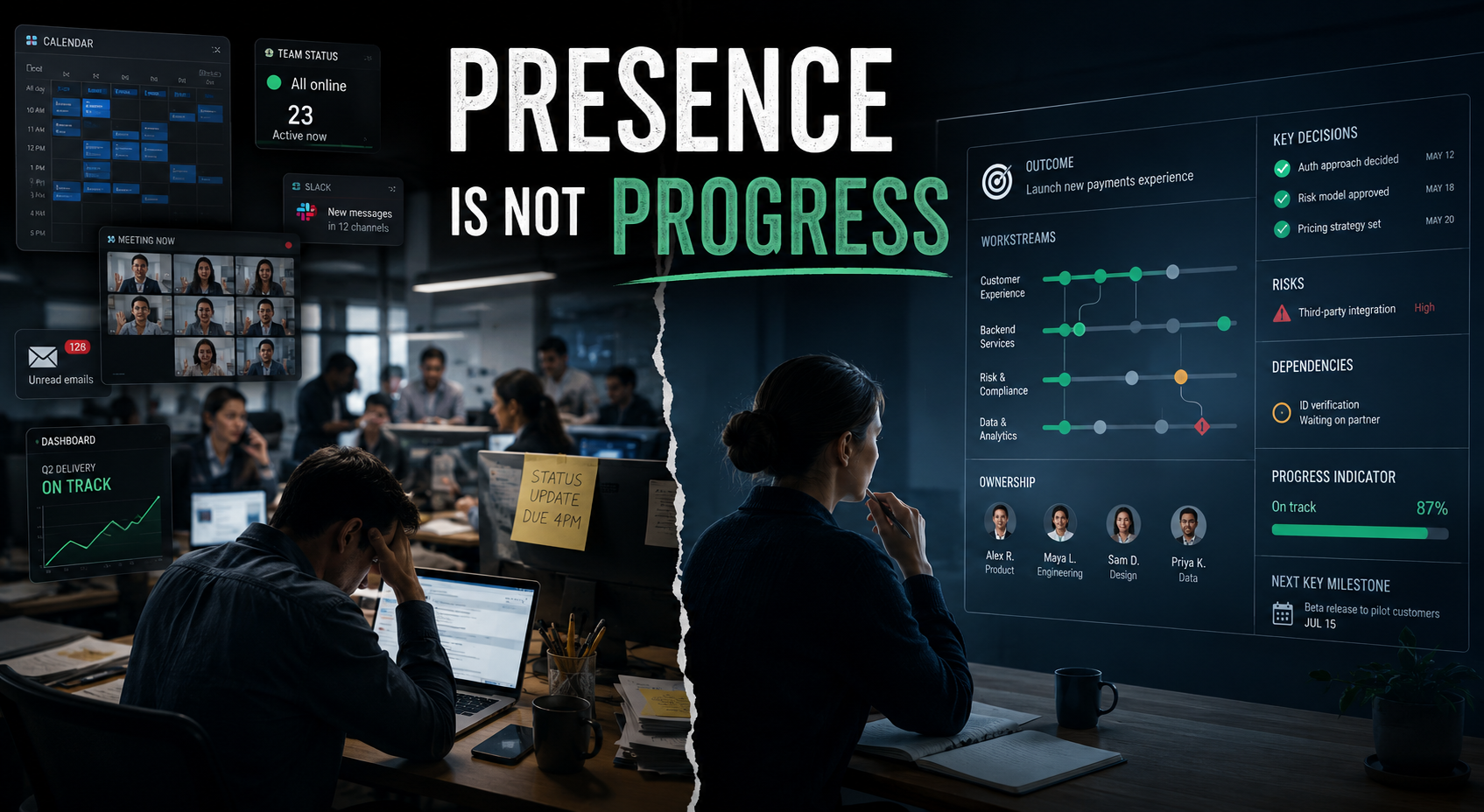
Take an initiative I’ve seen play out in different shapes across different organisations: a company is moving production lines to another continent. Dozens of domains are in motion simultaneously — engineering handoffs, legal agreements, HR transitions, logistics, client contracts, regulatory approvals, knowledge transfer. Every domain has its own pace, dependencies, and hidden risks.
The management response: two weekly status meetings. No risk inventory. No ownership matrix. No criteria for what “on track” means in each domain. No leading indicator that would tell you a thread is drifting before it becomes a crisis.
Just: everyone get in a room and report what you know.
That is presence management at full scale. And it is not a failure of effort or intent. It is a failure of operating design.
The same failure shows up in a product team that marks an SSO initiative green because implementation has started — while legal approval is pending, the enterprise rollout path is undecided, and nobody has resolved whether existing tenants will be migrated automatically. The dashboard tracks motion. The risk lives elsewhere.
Both situations share the same structural problem: leaders cannot see whether delivery is progressing, so they substitute visible activity for delivery intelligence. Add meetings. Add oversight. Add attendance requirements.
None of it creates the missing signal.
What Presence Management Actually Is
Before diagnosing the problem, it helps to separate three things that often get treated as one:
Office attendance — being physically in the building.
Meeting attendance — being present, online or in person, in recurring status calls.
Digital activity tracking — monitoring logins, messages, keystrokes, or availability signals.
These look different. But they share the same flaw: they measure whether work appears to be happening, not whether delivery risk is decreasing. That is what makes them presence management, regardless of which form they take.
Return-to-office mandates draw the most attention, but a team that spends every day in the same building running two status meetings with no defined risk criteria is no more observable than a distributed team that has never met.
The Misdiagnosis
The Wall Street Journal reported that 26% of U.S. paid workdays were still remote in May 2026 — almost 4x pre-pandemic levels. Remote work didn’t disappear; it became part of the operating model. And yet RTO mandates keep arriving.
Not all of them come from the same place. Some are control instinct. Some are executive distrust. Some are real estate economics. Some are genuine collaboration problems, onboarding concerns, or client-facing constraints. Some are middle-management weakness dressed up as strategy.
It would be too easy — and wrong — to say they all have the same root cause.
But there is a pattern in the ones that arrive after a delivery disappointment: leaders who cannot see how work is progressing reach for the only lever that makes progress feel visible. Presence.
That is the misdiagnosis. The delivery problem is not that people are in the wrong location. It is that the organisation lacks a management system that can see whether initiatives are moving toward outcomes.
Attendance is a crude proxy for that. The office becomes the workaround.
The Evidence Worth Using
In 2022, the UK ran one of the largest four-day-week trials ever attempted. 61 companies, roughly 2,900 workers, six months, no pay cut. 56 of 61 kept it after the trial.
Burnout fell for 71% of employees. Sick days fell 65%. Attrition fell 57%. Revenue held.
The tempting read is: workers got a day off and liked it. But that misses what actually happened.
The reduction forced companies to redesign the work before the trial started — clarifying priorities, tightening handoffs, eliminating coordination overhead, making better decisions. The day off was the reward. The redesign was the mechanism.
A 2025 study in Nature Human Behaviour tracked a similar intervention across 141 organisations in six countries with a control group. The productivity gains held. The study is careful not to overclaim; these were organisations that opted into the redesign, not a random sample.
The lesson is not that shorter weeks fix delivery. It is that the companies forced to redesign work — before the trial, as a precondition of the reduction — out-delivered organisations that never asked the question.
If you can remove an entire workday without breaking delivery, you have just revealed how much of the week was not delivery.
The management question that follows is the same one presence management fails to answer: can your organisation define what progress looks like without measuring time and attendance?
What Progress Observability Actually Means
“Observability” is a useful engineering metaphor, but it needs a precise definition to do work in a management context.
Work observability is the ability to answer, without asking for a status performance: what changed this week, what decision moved, what dependency cleared, what risk increased, what tradeoff is now required, and whether the outcome is more or less likely than before.
A manager with good observability does not need a packed calendar to know whether an initiative is drifting. A manager without it reaches for presence — meetings, offices, dashboards, attendance rules — because those are the only signals available.
That is why the fix is not more trust, fewer meetings, or remote-work ideology. Those are downstream preferences. The fix is operating design: building the structures that make work visible before a missed deadline reveals that it wasn’t.
There are five questions that tell you whether your operating design is working:
- What are we trying to deliver?
- Who owns each part?
- What does the work actually cost?
- Where are the risks and dependencies?
- What signal tells us we are drifting before the deadline breaks?
If your team can answer those five questions cleanly, you have observability. If they cannot, adding meetings and office days is not a fix — it is a workaround that makes the absence of a fix feel more comfortable.
The Concerns Worth Taking Seriously
Before reaching the operating playbook, it is worth taking the strongest argument on the other side seriously.
Executives who push for presence are not only trying to “watch people working.” They are also worried about things that are genuinely hard to solve remotely: slow onboarding, junior employees with less access to informal learning, cross-functional trust that erodes when people never share physical space, mentoring that depends on proximity, culture that fragments under distributed working.
Some of those concerns are legitimate. Offices can accelerate trust-building. In-person strategy sessions where divergence and debate are the point produce different outcomes than video calls. Some decisions that stall in async communication unlock quickly face-to-face.
The operating question, though, is not “are people near each other?” It is: are decisions, learning, handoffs, and risks moving faster because of the time together?
Presence management skips that question. It assumes proximity is the answer and never tests what problem it is actually solving. Used deliberately — for the work that genuinely needs co-presence — shared space earns its place. Used as a management default, it is a very expensive substitute for the operating design that is still missing.
What Managers Who Get This Do Differently
The five habits below are not equal in importance. The first three are the core of observable delivery. The last two matter, but they support the argument rather than making it.
1. Separate estimates from commitments
This one change would fix more delivery dysfunction than anything else on this list.
An estimate is a probabilistic model. A commitment is a leadership decision. When they get collapsed into the same conversation, three things happen: teams build hidden buffers that everyone knows about and no one names; bad news gets delayed because surfacing the estimate gap feels like failure; and leadership disappointment becomes structurally guaranteed from the start.
When they stay separate, tradeoffs can be made explicitly, at the right level, before the cost of making them is locked in.
2. Make the work visible before execution starts
Most roadmap items are labels, not scopes. “Add SSO” looks simple until you excavate what is inside it. The same applies to any initiative where complexity is distributed across domains.
Before execution starts, map each initiative across: outcome (what does done look like?), scope (what is explicitly excluded?), workstreams, dependencies, risks, unknowns, and tradeoffs. Not as documentation ceremony. As the actual work.
Everything downstream is cheaper when this exists. Blockers surface early. Cross-team dependencies get flagged before they become surprises. And the estimate becomes defensible.
3. Track leading indicators, not lagging ones
“On track / off track” is a trailing indicator. By the time something flips, most of the recovery window is already gone.
What managers with good observability watch instead:
- Decision velocity — are open decisions getting made, or are they sitting?
- Dependency movement — are the things you are waiting on clearing on schedule?
- Blocker aging — how long has each blocker been open, and who owns closing it?
These signals tell you drift is happening before the deadline reflects it. That is when intervention is still cheap.
4. Define ownership with precision
Ambiguous ownership is where delivery risk hides longest.
For every significant initiative, define — explicitly, not assumed — who is accountable for the outcome, who coordinates execution, who makes the technical calls, who can unblock a stalled decision, and who owns accountability after launch.
These are rarely the same person. When it is undefined, everyone assumes someone else.
5. Make tradeoffs visible before they become deadlines
Scope, date, capacity, quality, and risk are connected. Change any one and you move the others. When that is not named, the tradeoff does not disappear — it quietly gets absorbed into engineering estimates, where it eventually surfaces as a missed deadline with an unclear cause.
Make the tradeoff explicit early. Show what happens to the other variables when one gets fixed. Let the decision get made at the right level rather than invisibly pushed down to engineering.
Two supporting habits
Cut performative meetings. A meeting earns its time if it makes a decision that could not be made async, exposes a risk that was not visible, or unblocks a dependency that was stuck. Status updates that do not meet that bar should be written, not spoken. The time recovered compounds.
Use shared space for work that actually needs it. Strategy sessions where divergence matters. Discovery phases where ambiguity needs human resolution. Trust-building that depends on shared physical context. Those earn the cost. Video calls from the same building and status reviews in a conference room do not.
The Real Problem Has a Specific Name
A team that delivers without surveillance is not a trust story. It is an operating design story.
The teams that perform — remote, hybrid, or co-located — have solved the same underlying problem. Everyone can answer the five questions. Risks surface before they become deadlines. Ownership is unambiguous. Estimates and commitments are kept separate. Tradeoffs reach the people who can make them.
Add surveillance to weak operating design and you get resentment on top of slow delivery. Build good operating design and the question of where people sit becomes almost irrelevant.
The honest question was never: “Can I see my team working?”
It is: “Do I have a management system that shows me whether we are moving toward the outcome?”
If the building is your answer to that question, it is not your management system.
It is your workaround.
Sources:
- WSJ: “Why Work From Home Is Here to Stay” — the same WFH numbers are available free from Stanford’s WFH Research (Bloom, Barrero, Davis): wfhresearch.com
- UK four-day-week pilot, 61 companies, June–December 2022: autonomy.work
- 2025 study across 141 organisations in six countries, Nature Human Behaviour: nature.com