It’s 2026.
Every serious developer uses AI agents daily.
Code generation is no longer interesting or impressive.
Everyone already does it.
The real change isn’t that developers use AI.
It’s what they are responsible for when they do.
This is why the role is no longer accurately described as “software developer” or “engineer” in the traditional sense.
The role has evolved into something closer to what I call a Product Engineer.
The Shift: From Churning Tickets to Owning Product Translation
In most modern teams, developers no longer manually implement tickets end-to-end.
A sophisticated developer in 2026 typically works like this:
- They receive epics, not detailed stories
- They use an AI agent to expand those epics into actionable stories
- They run coding agents, testing agents, compliance agents, and sometimes deployment agents
The mechanical work is delegated.
What hasn’t been delegated — and cannot be — is responsibility.
The developer is now accountable for the transformation of product intent into executable reality.
That transformation is where most failures still happen.
Epic → Story Translation Is Now Core Engineering Work
A sophisticated developer today typically:
- Receives an epic
- Uses an AI agent to expand it into actionable stories
- Reviews and corrects those stories before any code is generated
The review step is the work.
It helps to think of an AI agent this way:
An AI agent is like a highly capable, deeply experienced developer with massive subject-matter knowledge — but it’s their first day on the job. Every time.
They understand patterns, technologies, and best practices instantly.
They do not know your system’s history.
They weren’t there for:
- the incident that happened at 2am
- the workaround that saved a customer
- the bug that only appears under very specific conditions
- the trade-off you made because “the obvious solution” broke something else
Each time you run an agent, it’s like onboarding a new hire — except instead of tribal knowledge living in their head, it must be encoded explicitly.
And while some guidance may be left behind from previous runs — prompts, guidelines, constraints — it’s still just notes for the next new hire, not lived experience.
This is why epic-to-story review matters.
The Product Engineer ensures that:
- known edge cases are explicitly reflected
- historical failures are encoded as requirements
- non-obvious constraints are written down, not assumed
AI can extrapolate intent extremely well.
But institutional knowledge only persists if engineers deliberately preserve it.
Let the Agents Read the Code — Then Use Their Output Wisely
Modern agents can (and should) read the codebase and existing implementation details to generate detailed stories.
This is a strength, not a shortcut.
A good Product Engineer uses agents intentionally:
- Let agents extract relevant modules, patterns, and dependencies
- Let them surface constraints already embedded in the system
- Let them propose story-level implementation detail grounded in reality
But here’s the important part:
Those agents should also generate the AI guidelines for downstream coding agents.
Instead of repeatedly re-feeding context into every coding run, Product Engineers:
- Reuse generated implementation constraints
- Persist architectural and behavioral guidance
- Optimize prompts to reduce token usage
- Focus spend and time on execution, not repetition
This is no longer about “prompt engineering” as a gimmick.
It’s about designing efficient agent pipelines.
Running the Coding Agent Is Not the Job — Owning the Outcome Is
By the time a coding agent runs, most of the work has already been done.
The Product Engineer’s responsibility at this stage is not to marvel at how fast code appears.
It is to review it with intent in mind:
- Does this code do what we meant, not just what we asked?
- Are trade-offs explicit and acceptable?
- Is the behavior observable in production?
- Does it fail safely?
- Is it consistent with how the rest of the system evolves or is planned to evolve next year?
AI-generated code is often plausible before it is correct.
The Product Engineer is the final authority on that distinction.
Testing Agents Change the Focus — Not the Responsibility
Testing agents in 2026 are extremely capable.
In practice:
- 90–95% of the time, they generate all the tests a developer expected
- 99.9% of the time, they generate more tests than the developer would have written manually
This is a massive productivity win.
But it also shifts the developer’s focus.
The Product Engineer no longer spends energy enumerating obvious cases.
Instead, they focus on the 1-in-20 scenario:
- the weird edge case learned from production incidents
- the historical failure no spec ever mentioned
- the interaction that only breaks under specific timing or data shapes
- the scenario that “should never happen” — but did
When that case is missing, the Product Engineer’s job is to add it to the test agent’s requirements, regenerate, and lock that knowledge into the system.
This is how experience compounds instead of being lost.
Compliance, Regulation, Deployment — Same Rule
Teams run agents for:
- compliance
- security
- regulation
- deployment checks
The pattern stays the same.
AI can scan, compare, flag, and suggest.
Responsibility doesn’t move.
The Product Engineer still owns:
- correct interpretation
- real-world constraints
- deployable, auditable systems
AI accelerates execution.
Humans own correctness.
Why the Developer Role Is Becoming “Product Engineer”
This is why the modern developer role is no longer about code.
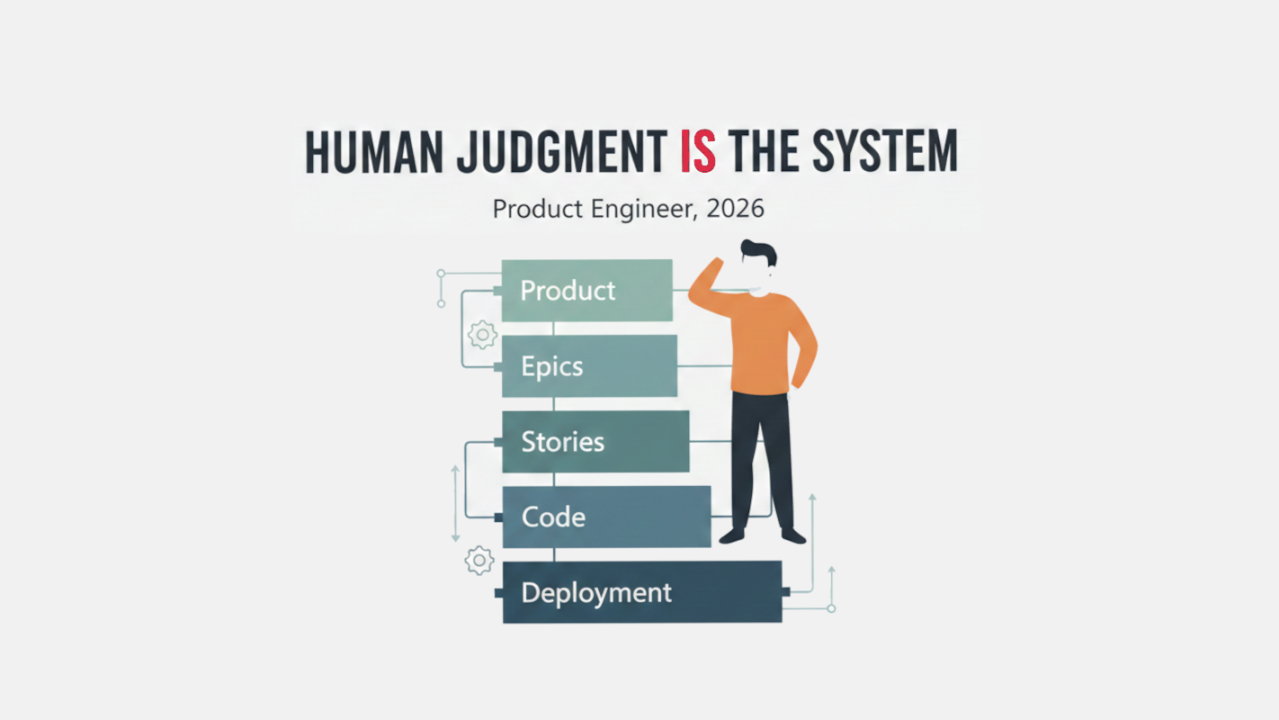
It is about seeing the entire system:
- product intent
- epic decomposition
- story-level execution
- code generation
- testing completeness
- compliance alignment
- deployment reality
The Product Engineer is the person who ensures that all of these layers remain aligned as work flows through multiple AI agents.
They are not a bottleneck.
They are a coherence layer.
Conclusion
In 2026, everyone uses AI to write code.
That’s not the differentiator.
The differentiator is who takes responsibility for:
- turning product intent into executable truth
- preserving hard-earned knowledge
- catching the edge cases agents still miss
- designing efficient agent pipelines
- owning outcomes instead of throughput
That’s why the role is evolving.
Not into “AI developer.”
Not into “prompt engineer.”
But into Product Engineer — someone who owns what ships, not just how it’s built.